
Answer Engine Optimization (AEO) helps websites improve their visibility in AI powered search answers. It makes information easier for search systems like ChatGPT, Perplexity, and Google AI Overviews to discover and interpret. Businesses use AEO to improve how their content supports relevant questions, citations, and brand discovery.
Finding the right top answer engine optimization for AI solutions means understanding both specialized tools and practical methods. Some platforms monitor citations and brand mentions, while others support content production or technical analysis. Choosing the right approach depends on your website’s goals, resources, and existing SEO performance.
This article compares leading AEO tools and services, including their capabilities, advantages, and limitations. It also explains 10 practical best practices for improving AI search visibility. You’ll learn how to select solutions, optimize content, avoid mistakes, and measure meaningful results.
What Is Answer Engine Optimization (AEO)?
Answer Engine Optimization is the process of improving content so AI powered answer systems can discover, understand, and potentially reference it. Traditional SEO focuses on improving visibility in search results, while AEO also considers direct answers generated by AI. The two approaches share technical, editorial, and credibility requirements.
AEO commonly involves content optimization, semantic relevance, technical accessibility, and source credibility. For example, a software company can publish clear explanations about AI workflow automation and its practical applications. An AI search platform may reference that information when answering a related question, although inclusion is never guaranteed.
Why AEO Matters for AI Powered Search
AI powered search can provide summarized answers without requiring users to open multiple webpages. This changes how businesses measure visibility and how readers discover information. A website can appear in an AI generated response even when the user does not click its link.
A 2025 Pew Research Center study found traditional result clicks occurred during 8% of Google visits containing AI summaries. That figure was 15% for visits without an AI summary. These observations demonstrate a difference in browsing behavior, although they do not prove AI summaries caused every difference.
For website owners, this makes traditional ranking data only part of the performance picture. AI citations, brand mentions, and relevant referral traffic provide additional information about online visibility. AEO complements SEO rather than replacing it.
How Does Answer Engine Optimization Work?
AEO works by improving the relevance, accessibility, and credibility of content that AI powered search systems may retrieve. Some AI search experiences use web indexes or live retrieval to gather information before generating answers. Each platform applies its own retrieval, processing, and citation methods.
The process can be understood through four stages. These stages simplify the technology rather than describing one universal system. Not every AI generated response involves a live website search.
- Discovery: Search crawlers locate accessible webpages through links, indexes, and other discovery methods.
- Retrieval: The search system identifies information relevant to the submitted question.
- Answer generation: An AI model prepares a response using available information.
- Source presentation: The interface may provide citations or supporting links.
What Influences AI Citations?
Relevant, accessible, accurate information is better positioned to support useful answers than unclear or inaccessible content. Descriptive headings, complete explanations, and original evidence help make information understandable. However, the precise citation selection process differs across AI search platforms.
For example, consider two webpages about AI customer support automation. One contains generic promotional claims, while the other explains features, integration requirements, limitations, and implementation steps. The second provides more specific information, although that alone cannot guarantee a citation.
AEO vs. SEO vs. GEO
AEO, SEO, and Generative Engine Optimization (GEO) overlap, but each emphasizes a different aspect of discovery. SEO primarily focuses on organic search performance, while AEO emphasizes direct answer visibility. GEO emphasizes visibility within generative AI responses, although industry definitions vary.
| Approach | Main objective | Example measurement |
| SEO | Improve traditional organic search visibility | Rankings, impressions, clicks |
| AEO | Improve visibility in direct answer experiences | Mentions, citations, referrals |
| GEO | Improve inclusion in generative AI responses | Source citations and AI visibility |
Google confirms that established SEO practices remain relevant to AI Overviews and AI Mode. It does not require special AEO markup for these experiences. Businesses should therefore maintain strong SEO foundations while improving content usefulness for AI search.
Top 10 Answer Engine Optimization Tools and Platforms
The main AEO tools help businesses monitor AI visibility, analyze citations, improve content, or investigate technical accessibility. Some solutions specialize in one function, while others provide several capabilities within a single platform. Understanding these differences prevents businesses from purchasing tools that cannot address their actual problems.
Quick Comparison of Leading AEO Platforms
| Platform | Primary strength | Suitable audience | Main consideration |
| Profound | AI visibility intelligence | Enterprises | Broad reporting requirements |
| Semrush AI Visibility | SEO and AI research | SEO professionals | Feature and plan limits |
| Ahrefs Brand Radar | Brand and competitor research | SEO and marketing teams | Dataset methodology |
| SE Visible | AI response monitoring | Marketing teams | Monitoring focus |
| Otterly.AI | Accessible AI monitoring | Small businesses | Prompt allowances |
| Peec AI | Citation analytics | Content teams | Limited execution capability |
| Scrunch AI | Competitive AI visibility | Growing brands | Implementation responsibility |
| AirOps | Content workflow automation | Content operations teams | Workflow setup |
| Writesonic | AI assisted content optimization | Content marketers | Human review required |
| Nostra AI | Crawler and infrastructure analysis | Technical teams | Crawl activity differs from citations |
These comparisons describe public product positioning rather than independent performance rankings. Platform coverage, pricing, and subscriptions may change after publication. Buyers should confirm current capabilities with each provider before making a decision.
1. Profound AI Visibility and Citation Intelligence
Profound is an AI visibility platform designed to help organizations understand their presence in AI generated answers. It supports analysis of brand mentions, cited sources, and competitor appearances across supported AI platforms. The platform also provides capabilities for connecting search visibility research with marketing workflows.
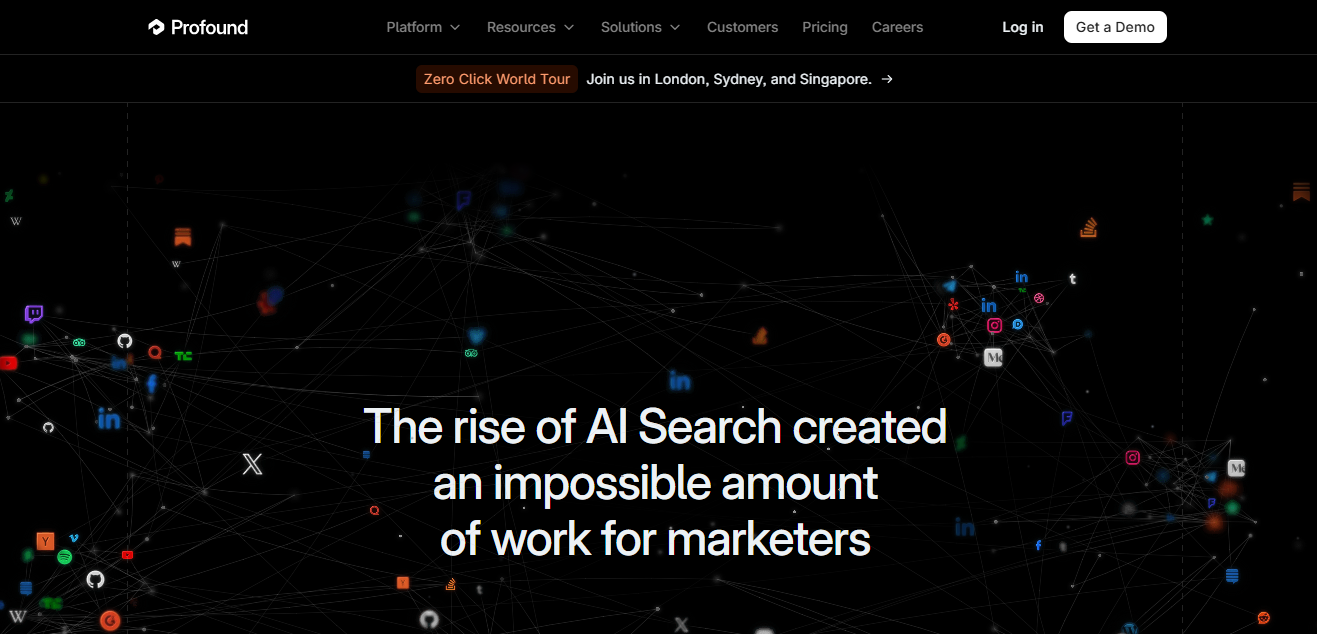
Its strengths include detailed monitoring, competitive intelligence, and reporting suited to larger organizations. However, smaller businesses may not need its full range of capabilities or reporting complexity. Profound is particularly relevant to enterprises managing multiple product categories or substantial marketing programs.
Best use case: An enterprise SaaS company wants to compare its mentions against competing software vendors. The company can monitor important product related prompts and examine which sources receive citations. Its marketing team can then investigate genuine information gaps without assuming every missing mention represents a content problem.
2. Semrush SEO and AI Search Analysis
Semrush combines established SEO research with AI search visibility capabilities. Its broader platform supports keyword research, technical audits, competitor analysis, and content optimization. AI visibility features extend this workflow to include brand appearances within supported AI search experiences.
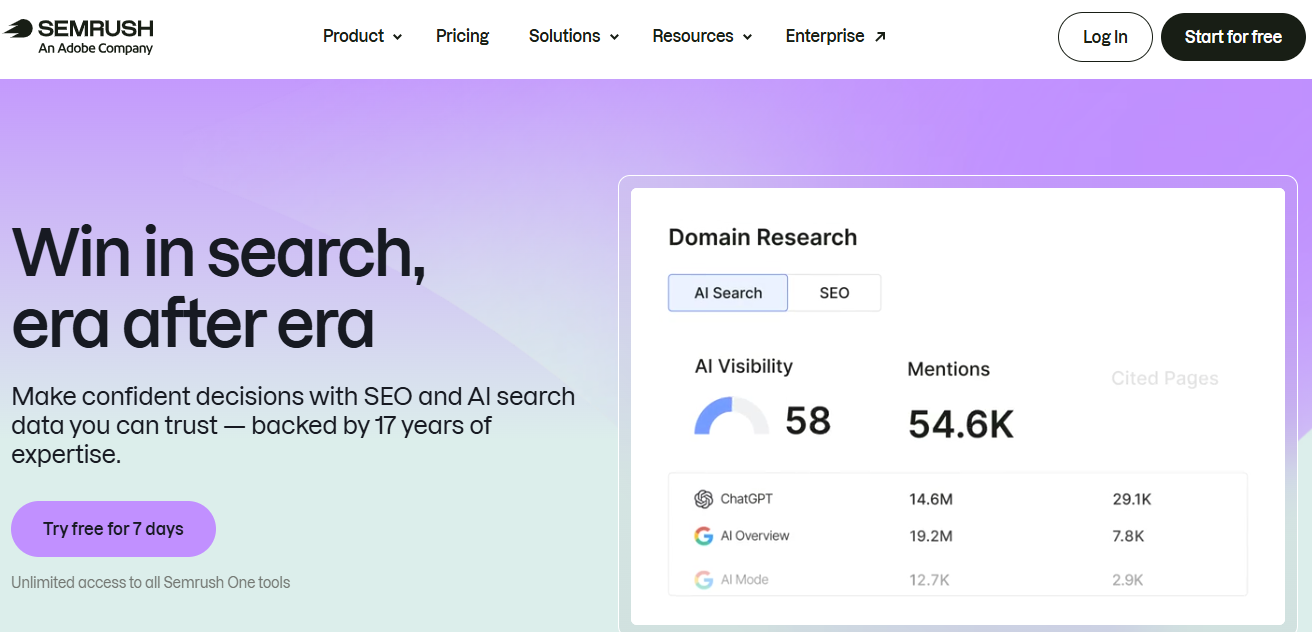
A major advantage is the relationship between traditional SEO research and AI visibility reporting. Teams can investigate organic rankings alongside recorded AI mentions and citations. However, available AI features, usage allowances, and pricing depend on the selected product and subscription.
Best use case: An SEO team wants to investigate why its website ranks organically but receives limited AI citations. It can compare search research with AI visibility observations and identify relevant content weaknesses. Those findings can support optimization decisions, although they cannot establish a guaranteed citation outcome.
3. Ahrefs Brand Radar AI Brand and Competitor Monitoring
Ahrefs Brand Radar helps businesses examine brand visibility across supported AI search environments. It connects AI visibility research with Ahrefs’ wider SEO and competitor analysis ecosystem. Relevant capabilities include analyzing mentions, cited sources, and competing brands within tracked search topics.
Its strength is providing a competitive perspective alongside established search research. However, modeled search demand and recorded AI responses should not be confused with unrestricted access to private user conversations. Marketers need to understand how the tracked question sample was collected before interpreting visibility estimates.
Best use case: An AI productivity company wants to discover which competitors appear in AI software recommendations. Brand Radar can support research into the related prompts and cited sources. The company can use those findings to improve useful content rather than simply copying competing pages.
4. SE Visible Multi Platform AI Visibility Monitoring
SE Visible focuses on analyzing how brands appear in AI powered answers. Its capabilities include visibility reporting, competitor monitoring, source research, and analysis of brand representation. It is associated with the SE Ranking ecosystem but focuses specifically on AI visibility.
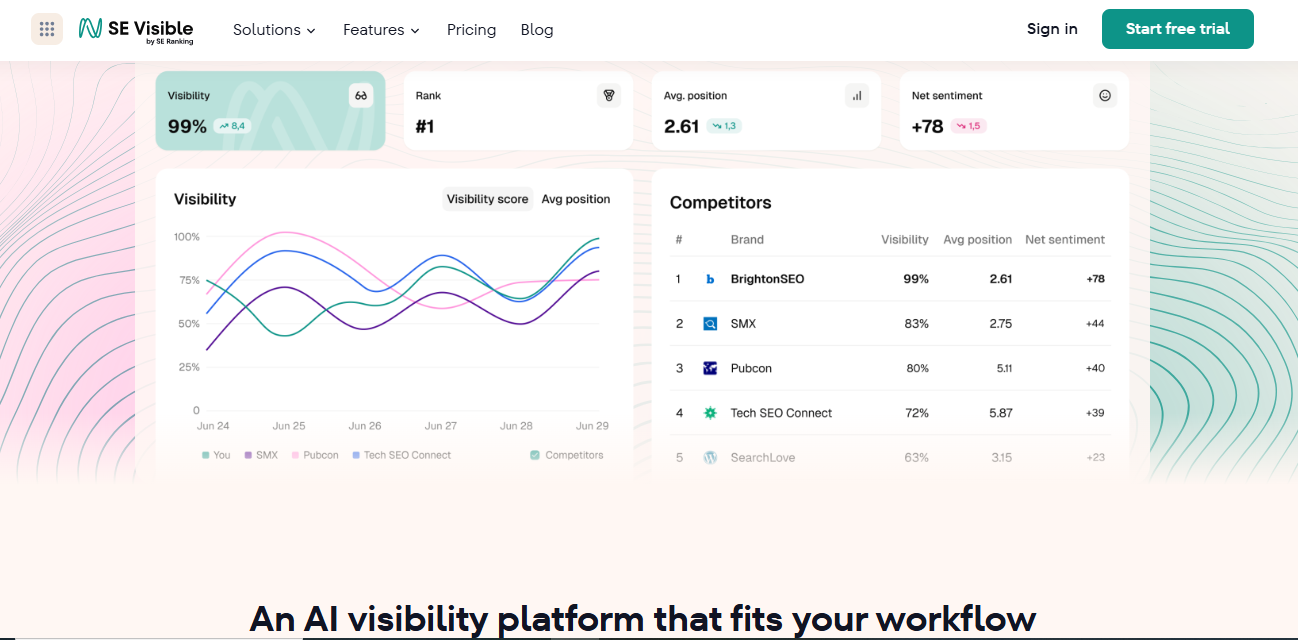
Its dedicated reporting makes it relevant for marketing teams managing regular AI search reviews. However, tracking a missing citation is different from fixing the content or technical issue behind it. Businesses still need editorial and technical resources to act on the findings.
Best use case: A software company wants to monitor whether its brand appears in relevant AI generated comparisons. Its marketing team can review citation and visibility trends over time. The results can help prioritize investigations into competitor sources and content coverage.
5. Otterly.AI AI Visibility Monitoring for Smaller Teams
Otterly.AI provides monitoring of brand appearances within supported AI search platforms. Businesses can track selected questions, observe brand mentions, and review supporting citations. Its focused approach makes it relevant to teams beginning structured AI visibility measurement.

A key advantage is the ability to start with a defined prompt set rather than a large analytics operation. However, the number of tracked prompts and available platform coverage depend on the subscription. Businesses should evaluate these limits before selecting a plan.
Best use case: A small AI consulting company wants to monitor 20 questions related to automation services. The company can compare its presence against selected competitors across supported platforms. Repeated monitoring can establish a useful baseline, but the sample does not represent the entire AI search market.
6. Peec AI Citation and Source Tracking
Peec AI focuses on helping marketers examine AI search visibility and supporting source citations. It can support investigations into which webpages receive citations for tracked questions. This is valuable for companies maintaining substantial educational content libraries.
A strength of citation focused monitoring is the connection between a generated response and its displayed sources. However, this information does not independently establish why an AI system selected a source. Content teams must still evaluate relevance, credibility, and possible technical limitations.
Best use case: An AI software publisher wants to compare citations earned by tutorials and product comparison pages. Peec AI can help identify patterns within monitored responses. The team can then decide whether additional explanations or clearer documentation would benefit readers.
7. Scrunch AI Competitive AI Search Visibility
Scrunch AI helps organizations analyze how their brands appear relative to competitors in AI generated responses. Its monitoring capabilities support competitive visibility research and investigation of related search questions. The platform also promotes specialized capabilities for AI focused website experiences.
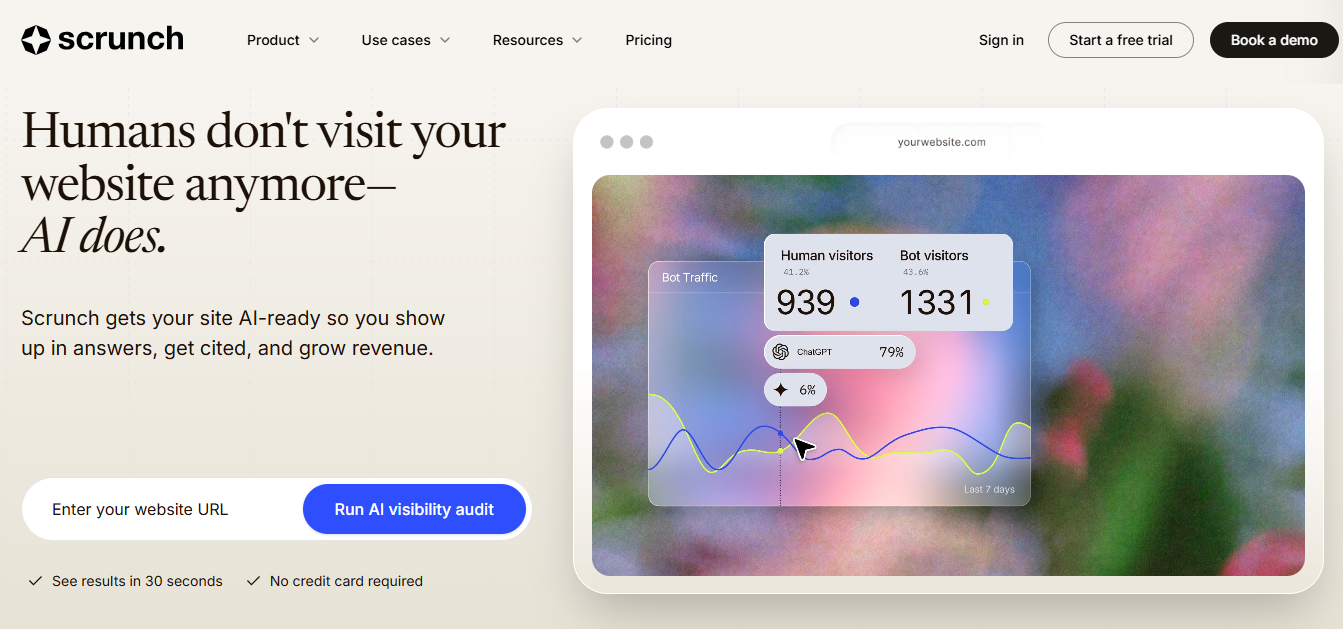
Competitor benchmarking is useful when a business operates in a crowded product category. However, a visibility comparison remains dependent on the chosen prompts and supported platforms. It should not be treated as a universal ranking across every possible AI generated response.
Best use case: An AI customer service software provider wants to understand which competitors appear in buying related questions. The company can examine recurring patterns and review the sources supporting competitor recommendations. It can then improve missing factual information within its own product and educational content.
8. AirOps Content Optimization and Workflow Automation
AirOps helps businesses organize and automate content research, production, and optimization workflows. It is particularly relevant to companies that maintain large libraries of articles or documentation. Its workflow capabilities can support content updates, research tasks, and structured editorial processes.
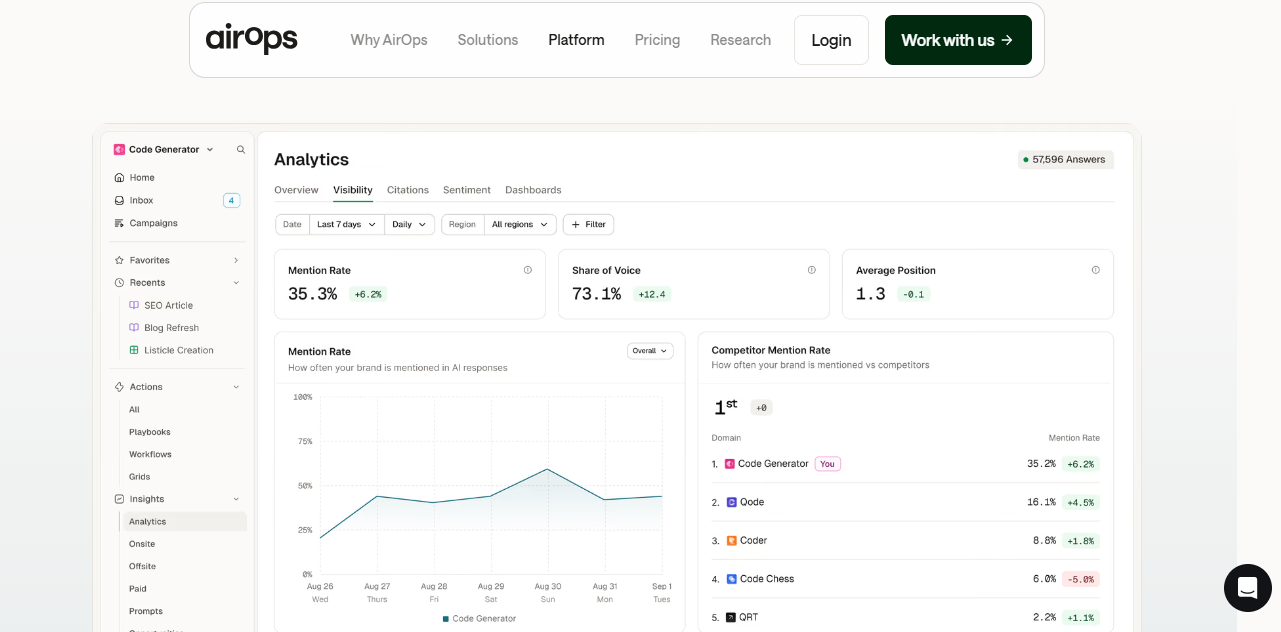
The main advantage is making repeatable content work more manageable. However, automation does not guarantee that generated information is accurate or worth publishing. Editorial reviews and reliable source material remain necessary.
Best use case: An AI SaaS company maintains 300 technical help articles that require regular review. AirOps can support a workflow for identifying changes and preparing updated drafts. Subject experts should verify technical accuracy before publication.
9. Writesonic AI Assisted Content Optimization
Writesonic provides AI assisted content production and related optimization capabilities. It supports activities such as drafting, research assistance, and content improvement. Its broader offering also includes AI search visibility functionality.
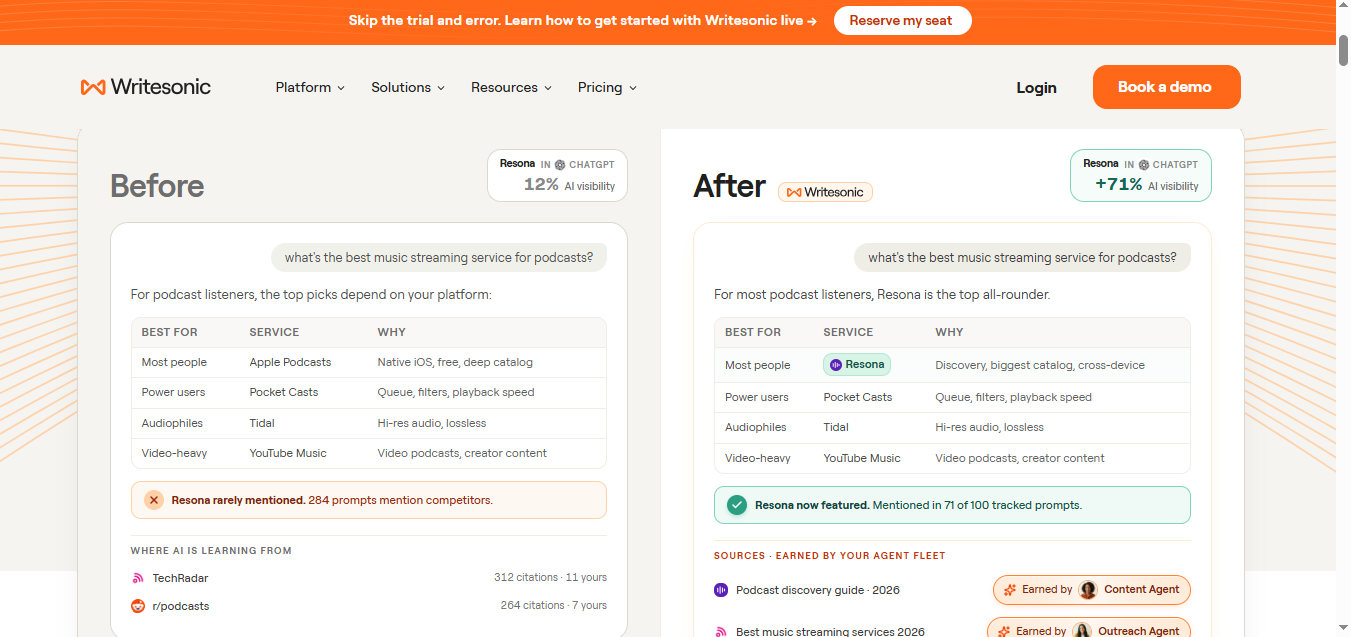
Its main strength is supporting teams that regularly produce and update marketing content. However, AI generated drafts may contain unsupported claims, repeated wording, or incomplete technical explanations. Human verification remains essential for accuracy and credibility.
Best use case: A marketing team wants to improve articles about AI workflow automation. Writesonic can support initial research and draft preparation. Editors should then add original examples, validate references, and remove generic explanations.
10. Nostra AI AI Crawler and Technical Visibility
Nostra AI approaches AEO through crawler monitoring and website infrastructure analysis. Its services help businesses investigate automated traffic and identify different types of website requests. This addresses a technical concern that ordinary AI mention dashboards may not fully explain.
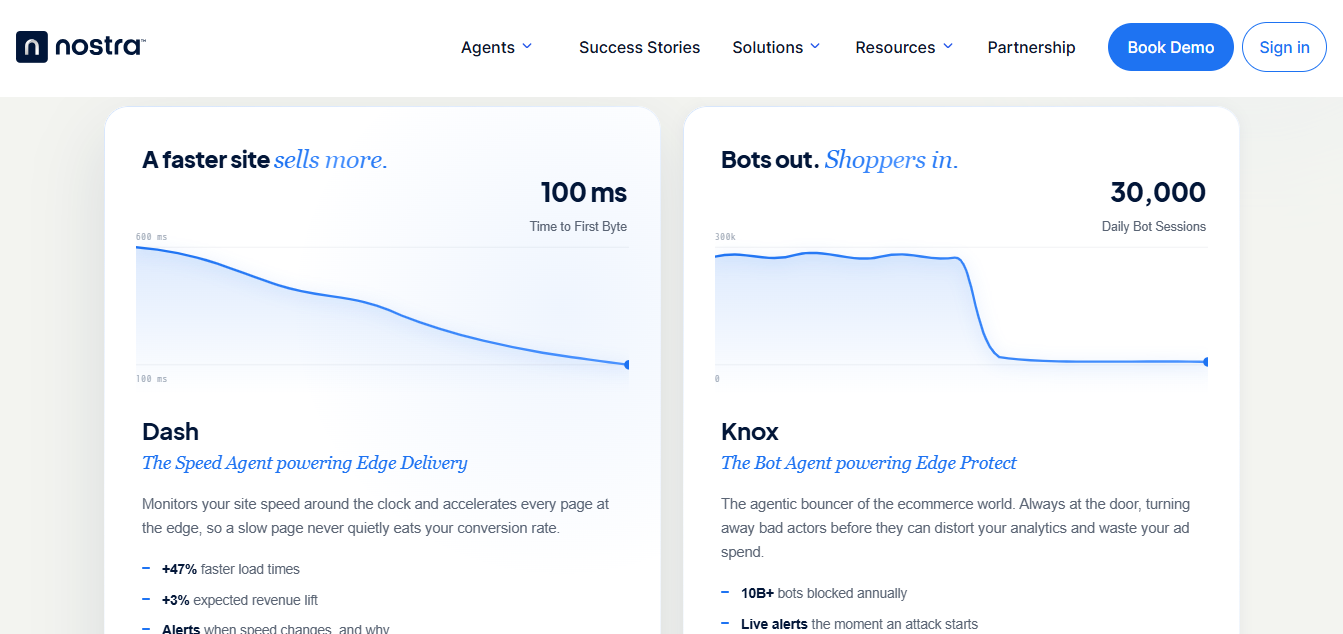
Crawler verification can help identify access patterns and distinguish legitimate requests from impersonating bots. However, observing an AI crawler request does not prove a webpage influenced a generated answer. Source citations and actual human referral traffic must be measured separately.
Best use case: A large ecommerce website receives automated traffic but lacks reliable crawler level analysis. Nostra can help its technical team investigate the incoming traffic. The findings can support infrastructure decisions alongside separate AI visibility monitoring.
AEO Agencies vs. AEO Software: Which Is Better?
AEO software provides data and workflow capabilities, while agencies can provide strategy, content production, and technical implementation. Neither option is automatically better for every business. The right choice depends on whether your team can act on the information it collects.
Specialized agencies such as iPullRank offer technical SEO, content architecture, and broader search optimization services. Other agencies focus on digital PR, editorial strategy, or ongoing AI visibility programs. Buyers should assess the actual service scope instead of assuming every agency provides identical AEO capabilities.
| Factor | AEO software | AEO agency |
| Main service | Monitoring, analysis, or workflow automation | Strategy and implementation |
| Control | Primarily internal team | Shared with outside provider |
| Technical execution | Depends on product | Depends on contract and agency skills |
| Content production | Available in selected platforms | Available when included in scope |
| Reporting | Dashboard based | Defined by agency agreement |
| Cost | Subscription or usage based | Project or retainer based |
An organization with an experienced SEO team may benefit from specialized monitoring software. A company without content or technical resources may need external implementation support. Before hiring an agency, request its methodology, deliverables, reporting process, and evidence supporting previous claims.
Top 10 AEO Best Practices for AI Search Visibility
Effective AEO depends on clear answers, semantic relevance, reliable information, technical accessibility, and consistent measurement. These ten practices support website quality alongside traditional SEO. None guarantees placement in AI generated answers.
1. Answer Important Questions Directly
Begin relevant sections with a clear answer to the user’s question. Readers should understand the main point without searching through unrelated information. Supporting details can follow after the direct explanation.
For example, a section asking “What is AI workflow automation?” should define the term immediately. It can then explain practical uses, implementation requirements, and limitations. This structure improves clarity for readers and makes the information easier to interpret.
2. Optimize for Conversational Search
Conversational optimization addresses natural questions containing specific needs and context. People may ask an AI assistant for a solution rather than entering a short keyword. Content should address the complete information need where relevant.
For example, “AI chatbot software” is a broad search phrase. “Which chatbot can handle customer support without a large technical team?” describes a more specific requirement. A useful explanation should address setup complexity, supported workflows, and practical limitations.
3. Use Semantic Keywords and Related Entities
Semantic SEO improves clarity by explaining related concepts within their proper context. An AEO article may naturally discuss information retrieval, AI citations, website crawlability, and structured data. These subjects help explain the primary topic without unnecessary repetition.
For example, a guide about AI customer support can explain natural language processing, ticket routing, and software integration. Each concept should have a clear relationship to the reader’s question. Unrelated keyword additions do not improve the usefulness of the article.
4. Build Topical Authority
Topical authority involves publishing reliable, connected information about a defined subject. A website should cover meaningful questions instead of creating numerous pages with nearly identical explanations. Useful internal links can connect articles when readers need additional context.
For example, an AI automation company might explain workflow design, software integrations, implementation costs, and system limitations. Each page can address a separate learning need. This creates a useful resource library without duplicating the same answer.
5. Provide Original Evidence
Original evidence makes content more useful and easier to verify. Research findings, product tests, technical demonstrations, and documented experience can support important claims. Evidence should accurately represent what was measured.
For example, a company describing automation savings should explain the original process and measurement method. It should identify the observed result and important limitations. Unsupported promises about productivity or revenue should not replace verifiable findings.
6. Organize Content Clearly
Clear headings and focused explanations help readers find information quickly. Use a descriptive H1 for the primary subject and H2 headings for major topics. Add H3 headings only when a topic needs further organization.
Use comparison tables when evaluating products or approaches against consistent criteria. Use numbered lists for genuine sequences, such as implementation steps. Avoid splitting every sentence into a separate section.
7. Apply Relevant Structured Data
Structured data helps search engines interpret supported information about a webpage. Schema.org vocabulary can describe articles, organizations, products, and other eligible content types. JSON LD is one supported method of implementing this information.
For example, Article markup can identify a headline, author, and publication date. The information must accurately match visible webpage content. Google does not require a special AEO schema for AI Overviews or AI Mode.
8. Improve Technical Accessibility
Technical accessibility helps search crawlers reach important webpage content. Website owners should review robots.txt, indexing directives, server responses, and access restrictions. They should also confirm important information is available without unnecessary technical barriers.
Different AI related crawlers perform different functions. OpenAI identifies OAI SearchBot for search related discovery and GPTBot for potential training related crawling. Allowing one crawler does not mean every AI system will cite the website.
9. Strengthen Internal Links and Credible References
Internal links connect related webpages and help readers explore relevant information. Use descriptive anchor text that accurately represents the destination. Link to supporting resources when the additional information improves understanding.
External references should support important factual claims. Official documentation and original research are useful when explaining technical behavior or reported statistics. However, linking to authoritative sources does not guarantee AI citations.
10. Monitor Performance and Update Information
Regular measurement helps businesses understand how selected content performs across AI search experiences. Track relevant questions consistently instead of checking unrelated prompts each week. Record mentions, citations, and supporting URLs where available.
Update important pages when product capabilities, factual information, or technical requirements change. A competitor appearing in an AI answer may reveal a relevant topic worth investigating. It does not automatically mean that copying the competitor’s content will improve visibility.
How to Optimize an AI Software Website: Practical Example
AEO optimization becomes easier to apply when you compare weak content with a clearer alternative. Consider a fictional company selling AI customer support software. Its website describes the product using general marketing claims but provides limited implementation information.
Before Optimization
“Our advanced AI platform transforms customer experiences using innovative automation technology.”
This statement offers little information about the product’s actual functionality. A reader cannot determine which customer support tasks the software handles. The description also provides no details about integrations, limitations, or setup requirements.
After Optimization
“Our AI customer support software answers routine customer questions and routes complex requests to human agents. It connects with supported help desk platforms and customer information systems. Setup requirements depend on the selected integration and support workflow.”
This version explains what the software does and where human involvement remains necessary. It also identifies integration requirements without promising universal compatibility. Readers can evaluate the product’s usefulness more easily.
What Improved?
| Content element | Before | After |
| Main explanation | Vague promotional claim | Specific product function |
| Search intent | Limited information | Addresses practical questions |
| Credibility | Unsupported language | Descriptive, checkable statements |
| Technical detail | Missing | Integration requirements included |
| User value | Difficult to evaluate | Easier to assess suitability |
The company could expand the page with supported integrations, security details, pricing information, and implementation guidance. It should then monitor relevant AI search prompts while comparing website analytics. Any changes in citations would remain observations rather than proof that one rewrite caused the result.
How to Choose the Right AEO Solution
Choosing an AEO solution starts with identifying the problem your website needs to solve. Different platforms offer monitoring, research, content automation, or technical analysis. Buying software before defining the requirement can create unnecessary costs.
Compare Important Capabilities
Evaluate whether the tool provides relevant AI platform coverage and usable citation data. Ask how it selects prompts, records responses, and calculates visibility scores. Confirm whether reports include source URLs and historical comparisons.
| Evaluation factor | Important question |
| AI platform coverage | Which answer engines are monitored? |
| Prompt methodology | Are prompts observed, configured, or modeled? |
| Citation tracking | Are source URLs available? |
| Monitoring frequency | How often are responses collected? |
| Competitor research | Can brands be compared using consistent prompts? |
| Content assistance | Can the tool help implement improvements? |
| Pricing | What limits apply to usage and accounts? |
| Export options | Can the underlying observations be reviewed? |
Understand the Cost
AEO implementation can begin with existing SEO resources and manual content improvements. Paid platforms typically charge according to subscriptions, tracked prompts, websites, or additional capabilities. Agencies may charge for strategy, technical work, content production, and reporting.
Compare what each subscription actually includes instead of focusing only on the headline price. A low monthly price may cover fewer prompts or supported engines than your project requires. Always verify published pricing and usage limits before purchasing.
How to Measure Answer Engine Optimization Performance
AEO performance should be measured through AI mentions, citations, referral traffic, and meaningful business outcomes. Traditional keyword rankings remain useful but do not describe every AI generated answer. Monitoring should distinguish what the platform observed from the wider search market.
Important AEO Metrics
| Metric | Definition | Illustrative example |
| Brand mention rate | Share of tracked responses mentioning your brand | 12 of 40 responses |
| Citation rate | Share of tracked responses citing your site | 8 of 40 responses |
| AI referral traffic | Identifiable website visits from AI services | 65 monthly visits |
| Conversion rate | Share of relevant visits producing an action | 5 of 50 visits |
The examples above are hypothetical and do not represent actual campaign performance. A citation rate calculated from 40 tracked responses only describes those responses. It should not be presented as a universal share of AI search.
Calculate Brand Mention Rate
Brand mention rate = (Responses mentioning your brand ÷ Total tracked responses) × 100
For example, 12 brand mentions across 40 tracked responses produce a 30% mention rate. This calculation can be repeated using the same prompt set and testing method. Differences should be interpreted carefully because generated responses can vary between sessions.
Measure AI Referral Traffic
Google Analytics 4 can help identify referral traffic arriving from supported AI search services. Website owners can also analyze relevant user actions after an identifiable referral. However, not every AI mention leads to a trackable website visit.
A person may discover a brand in an AI answer and visit the website later. That later activity may not be attributed to the original AI interaction. Referral traffic therefore provides useful evidence but not a complete measure of brand influence.
Common AEO Mistakes to Avoid
Common AEO mistakes involve keyword stuffing, unsupported claims, misleading measurement, and weak technical foundations. These problems can reduce content usefulness or make performance reports unreliable. Correcting them should be part of regular website maintenance.
Mistake 1: Repeating Keywords Excessively
Repeating the primary keyword does not guarantee better visibility. Forced wording can make explanations difficult to read. Use natural variations only when they clarify the subject.
Mistake 2: Trusting AI Generated Content Without Review
AI generated drafts can contain factual errors and unsupported claims. Publishing them without verification may reduce content reliability. Review important details against credible sources before publication.
Mistake 3: Assuming Schema Guarantees Citations
Structured data can help describe webpage information. It does not control the citation decisions of AI search platforms. Use schema correctly without treating it as a guaranteed ranking mechanism.
Mistake 4: Ignoring Crawler Accessibility
A useful article may remain difficult to discover when important crawlers cannot access it. Robots.txt restrictions, indexing directives, and server problems require technical review. Confirm accessibility before investing heavily in additional content.
Mistake 5: Confusing Crawler Traffic With AI Visibility
An automated request only shows that a crawler accessed a webpage. It does not prove the page appeared in a generated answer. Monitor citations and human traffic separately.
Mistake 6: Trusting One AI Response
AI generated answers can change across platforms and repeated tests. One screenshot cannot establish a stable ranking position. Use consistent prompt sampling and repeated observations.
Mistake 7: Measuring Mentions Without Business Context
A brand mention does not automatically generate a visit or lead. Businesses should also examine referral traffic and meaningful user actions. Separate observable outcomes from assumed commercial benefits.
Frequently Asked Questions About AEO
What Is the Best AEO Tool?
The best AEO tool depends on the website’s main requirement. Profound and SE Visible focus on AI visibility analysis, while AirOps emphasizes content workflows. Ahrefs and Semrush connect AI research with broader SEO capabilities.
Can I Start AEO for Free?
Yes, foundational AEO improvements can begin without paid software. Website owners can improve content clarity, technical accessibility, and internal linking using existing resources. Manual AI response checks can also establish a limited visibility baseline.
How Long Does AEO Take to Show Results?
AEO does not have a guaranteed timeline. Discovery, indexing, retrieval, and citation behavior vary between platforms. Consistent measurement can establish trends, but results are not promised within a fixed number of days.
Is AEO Better Than Traditional SEO?
AEO is a complementary approach rather than a replacement for SEO. Traditional SEO supports technical accessibility, organic discovery, and website relevance. AEO places additional emphasis on direct answer usefulness and AI search visibility.
Can Small Businesses Benefit From AEO?
Small businesses can use AEO practices to improve how clearly they explain their services. A company can publish useful answers about product features, requirements, and customer problems. The commercial value depends on audience behavior and measurable outcomes.
Does AEO Guarantee ChatGPT Citations?
No, AEO cannot guarantee a citation within ChatGPT or another AI platform. Website accessibility and helpful content can support potential discovery. Source inclusion still depends on the platform’s retrieval process and the particular question.
Conclusion
Effective Answer Engine Optimization combines credible information, useful content, technical accessibility, and reliable measurement. Specialized AEO platforms can help businesses monitor AI mentions, examine citations, and manage content workflows. However, the software must match an actual need and support decisions the organization can implement.
The 10 best practices provide a starting point for improving content quality and AI search readiness. Begin with relevant customer questions, strengthen existing webpages, and review important technical settings. Use consistent measurement to distinguish real improvements from temporary variations in AI generated answers.
The goal is not merely to appear in more AI responses. It is to make your website a useful, accurate, and accessible source of information. Sustainable improvement requires regular content maintenance, transparent measurement, and alignment with genuine reader needs.