

Choosing a front end development company is difficult when every agency promises similar results. Their portfolios may look impressive, but pricing, expertise, and delivery standards often differ. Selecting the wrong partner can create delays, unexpected expenses, and maintenance problems.
The top front end development companies build responsive websites, interactive applications, and user friendly digital products. They use technologies like React, Angular, Vue.js, and Next.js to meet different business requirements. Their capabilities range from custom interface development to enterprise software modernization.
This article compares 15 front end development companies in 2026, including their expertise, services, client feedback, and available pricing. You’ll also learn how to evaluate agencies, estimate development costs, and identify suitable project partners. The goal is to help you make an informed hiring decision using verifiable information.
Top Front End Development Companies in 2026
The top front end development companies in 2026 include Gilzor, Merixstudio, Cleveroad, Vention, Netguru, and 10 additional providers. These companies offer different combinations of front end engineering, interface design, and product development. Their suitability depends on project requirements, technology expertise, budget, and delivery expectations.
The following shortlist combines front end specialists with broader software development and web design agencies. Each profile explains the company’s services, technical capabilities, project experience, and available commercial information. The numbering organizes the shortlist and does not represent an independently calculated performance ranking.
1. Gilzor
Gilzor provides front end development, custom software engineering, and digital product development. Its listed offices include Warsaw, Poland, and Limassol, Cyprus. The company works with startups, product businesses, and organizations modernizing existing applications.
Gilzor specializes in React, Next.js, TypeScript, and JavaScript development. Its services include SaaS interfaces, design systems, responsive applications, accessibility improvements, and API integration. It also supports performance optimization, front end testing, and gradual modernization of legacy codebases.
According to its website, Gilzor has launched 70+ products, with 98% reportedly delivered on time. Its published healthcare case study reports a 30% increase in laboratory test orders. These are company reported outcomes rather than independently audited performance statistics.
Best suited for: SaaS startups, React based applications, existing product modernization, and dedicated front end engineering.
Pricing: Custom quotations, fixed price discovery engagements, and monthly billing for dedicated engineers. A standardized public hourly rate was not verified.
2. Merixstudio
Merixstudio is a Poland based software development company specializing in custom web applications and digital products. Its headquarters are in Poznań, Poland. The company combines front-end engineering, product design, back-end development, and software consulting.

Its technology experience includes React, Angular, Vue.js, JavaScript, and related development frameworks. Its services cover application architecture, custom interfaces, software modernization, and dedicated engineering support. Merixstudio works with businesses developing complex platforms and existing software products.
Clutch lists Merixstudio with a 4.8/5 rating from 97 reviews. Client feedback frequently highlights communication, technical quality, and project management. Some reviews also identify resource availability and project delays as areas requiring attention.
Best suited for: Enterprise applications, complex SaaS products, and businesses needing cross-functional engineering expertise.
Pricing: 50–99 per hour, with a listed minimum project size of $25,000.
3. Cleveroad
Cleveroad provides custom software development, web engineering, and technology consulting. Established in 2011, it maintains a headquarters listing in New York and research operations in Tallinn. Its clients include startups, scaling businesses, and enterprises.
Cleveroad develops web applications using technologies like React, Angular, Vue.js, and TypeScript. Its wider services include interface design, API integration, product discovery, application testing, and cloud architecture. It has documented work across healthcare, fintech, logistics, and education.
The company reports building more than 300 software products since its establishment. Clutch lists a 4.9/5 overall rating from 82 displayed reviews. These figures provide useful context but do not replace direct technical evaluation.
Best suited for: Startups, custom business applications, healthcare platforms, and businesses needing full cycle product engineering.
Pricing: 25–49 per hour, with a listed minimum project size of $10,000.
4. Vention
Vention provides software engineering services and dedicated development teams for technology businesses. Its headquarters are listed in New York, with delivery operations serving international clients. The company specializes in extending engineering capacity and delivering custom applications.
Vention’s front end services include React, Angular, Vue.js, Next.js, and TypeScript development. It supports responsive applications, design implementation, automated testing, and performance optimization. Its engagement models include dedicated engineering teams and broader development partnerships.
Clutch lists Vention with a 4.9/5 rating from 103 reviews. Client feedback frequently highlights delivery timelines, development quality, and collaboration. Buyers should still confirm the availability of engineers with experience in their required technology stack.
Best suited for: Growing SaaS companies, enterprises, and businesses requiring long-term engineering capacity.
Pricing: 50–99 per hour, with a listed minimum project size of $50,000.
5. Netguru
Netguru is a Polish digital product development company offering software engineering, design, and consulting. Founded in 2008, it operates from Poznań, Poland. Its current service positioning emphasizes digital commerce, application modernization, and product engineering.

Netguru supports React and TypeScript development alongside user experience design and back-end engineering. Its services include custom applications, digital commerce platforms, interface modernization, and software maintenance. The company has worked on digital products involving customer facing interfaces and complex business functionality.
Clutch lists Netguru with a 4.8/5 rating from 73 reviews. Its feedback highlights project management, responsiveness, and development quality. Some clients identify relatively high pricing as a consideration.
Best suited for: Digital commerce, SaaS platforms, product modernization, and businesses needing design and engineering services together.
Pricing: 50–99 per hour, with a listed minimum project size of $50,000.
6. WPWeb Infotech
WPWeb Infotech is an India-based development company offering web applications, eCommerce development, and custom software services. Its headquarters are in Ahmedabad, India. The company also offers dedicated development resources for businesses requiring ongoing support.

Its technology experience includes React, JavaScript, PHP, WordPress, Drupal, and related web development tools. Its services cover custom interfaces, website development, content management, API integration, and maintenance. Published client reviews document work involving custom WordPress development and Drupal support.
Clutch lists WPWeb Infotech with a 5.0/5 rating from 87 displayed reviews. The company also advertises separate monthly packages for dedicated development resources. Buyers should distinguish those packages from its general agency rate and project minimum.
Best suited for: Business websites, content management projects, eCommerce development, and dedicated web development support.
Pricing: Below $25 per hour, with a $25,000 listed agency project minimum.
7. Devox Software
Devox Software offers custom software engineering, front end development, and application modernization. Its service offering addresses new product development and improvements to existing software. The company also provides broader engineering support beyond interface implementation.

Devox works with modern JavaScript-based development technologies, including React and Angular. Its services cover responsive application development, integration, performance improvement, and legacy code modernization. It also supports software testing and maintenance after development.
The company’s published portfolio includes ActivePlace, a social marketplace for wellness communities. The project documentation identifies Angular among the technologies used during development. This provides a relevant example of its experience with interactive web applications.
Best suited for: Legacy application modernization, custom web platforms, and businesses needing front end and back end integration.
Pricing: Custom quotation required; a reliable standardized hourly rate was not established.
8. KitRUM
KitRUM provides software development, dedicated engineering teams, and product development services. Its listed locations include Miami, Florida, and Warsaw, Poland. The company works with technology businesses requiring new functionality, application modernization, or engineering capacity.

KitRUM’s experience includes React development, Angular migration, and web application integration. Its services cover custom software engineering, front-end development, application maintenance, and team extension. Relevant project experience includes financial software and existing product modernization.
A verified Clutch review describes an Angular to React migration for a lending application. The client reported 40% faster loading and 30% better time to interact after the engagement. These results represent one reported project outcome, not a guaranteed improvement.
Clutch lists KitRUM with a 5.0/5 rating from 73 reviews. Its published pricing places it within the midrange of this comparison. Buyers should request engineers with direct experience in their specific architecture.
Best suited for: Fintech, React migrations, SaaS platforms, and dedicated engineering support.
Pricing: 50–99 per hour, with a listed minimum project size of $25,000.
9. eSparkBiz
eSparkBiz is an India-based software development company offering custom web applications and engineering services. Established in 2010, it works with international businesses across different software requirements. Its services include both complete application development and dedicated developer hiring.

eSparkBiz supports React, Angular, Vue.js, JavaScript, and related software technologies. Its services include custom front end development, API integration, responsive design, and application modernization. The company also provides back end development, cloud support, and ongoing maintenance.
Clutch lists eSparkBiz with a 4.9/5 rating from 70 reviews. Review summaries frequently mention responsiveness, cost value, and project delivery. However, buyers should verify whether the proposed team has completed comparable front end projects.
Best suited for: Cost conscious software development, custom web applications, and businesses considering outsourced engineering teams.
Pricing: Below $25 per hour, with a listed minimum project size of $10,000.
10. Thoughtbot
Thoughtbot is a software consultancy specializing in product design, web development, and engineering collaboration. Founded in 2003, it operates internationally and lists New York among its locations. The company supports both early product development and improvements to established applications.

Its front end work includes React, JavaScript, HTML, CSS, and interface engineering. Thoughtbot also develops back-end functionality using Ruby on Rails and related technologies. Its services emphasize product discovery, iterative delivery, code quality, and development team collaboration.
Thoughtbot has documented work involving an educational platform for Tulsa Public Schools. The project combined React and Ruby on Rails to support education-related functionality. This provides evidence of experience connecting front end interfaces with back end applications.
Clutch lists Thoughtbot with a 4.9/5 rating from 39 reviews. Its published hourly range is higher than several other providers in this comparison. The business should evaluate that cost against its need for consulting and senior engineering support.
Best suited for: Product discovery, complex applications, startup products, and businesses needing collaborative engineering expertise.
Pricing: 150–199 per hour, with a listed minimum project size of $10,000.
11. Tooploox
Tooploox is a Poland based technology company specializing in software engineering, artificial intelligence, and product development. Established in 2012, it maintains locations in Wrocław and Warsaw. Its services combine application development with technical consulting and engineering support.

Tooploox has experience developing React interfaces and integrating them with existing software. Its broader technology expertise includes Python, AI development, and application architecture. Current service offerings emphasize AI alongside web and mobile product engineering.
A Clutch review documents its involvement in a construction software platform using React. The engagement included development support and integration with existing functionality. This provides relevant project evidence, although front end development is not its only specialization.
Clutch lists Tooploox with a 4.8/5 rating from 35 reviews. Review summaries mention engineering quality and flexibility, alongside occasional communication and resource availability concerns. Buyers should confirm dedicated front end capacity before starting a project.
Best suited for: SaaS platforms, complex software applications, and products combining web interfaces with AI functionality.
Pricing: 50–99 per hour, with a listed minimum project size of $25,000.
12. Orbit Media
Orbit Media Studios is a Chicago based web design and digital marketing agency. Its services focus on creating business websites with clear navigation and effective content presentation. The company combines front-end implementation with design, content strategy, and marketing expertise.

Orbit Media specializes in responsive website development, WordPress implementation, and website optimization. Its services also include redesigns, content management, technical SEO, and ongoing improvements. These capabilities differ from agencies primarily developing complex React based SaaS applications.
The company has published a website redesign case study for Kikkoman USA. That case study reports a 408% increase in organic Google Search clicks. This is a company reported marketing outcome, not an independently verified technical performance benchmark.
Clutch lists Orbit Media with a 5.0/5 rating from 36 reviews. Its project minimum is higher than several software focused providers in this shortlist. Buyers should assess whether its website and marketing specialization matches their requirements.
Best suited for: B2B websites, corporate website redesigns, WordPress development, and content driven digital experiences.
Pricing: 150–199 per hour, with a listed minimum project size of $50,000.
13. Shakuro
Shakuro is a digital product design and development company offering custom websites and interactive applications. Its listed location is Dubai, United Arab Emirates. The company combines interface design with software engineering and product development.
Shakuro supports React, Next.js, JavaScript, and TypeScript development. Its services include SaaS interface development, custom dashboards, website design, prototyping, and responsive implementation. It also works on visual design and interactive user experiences.
Clutch lists Shakuro with a 5.0/5 rating from 63 reviews. Client feedback frequently highlights design quality, communication, and timely delivery. Its published project minimum is lower than several enterprise oriented providers in this comparison.
Best suited for: Design focused SaaS applications, startup product interfaces, dashboards, and custom website projects.
Pricing: 25–49 per hour, with a listed minimum project size of $5,000.
14. BairesDev
BairesDev is a software development company providing dedicated engineering teams, outsourcing, and staff augmentation. Founded in 2009, it lists San Francisco as its headquarters. Its engineering operations support businesses across North America and Latin America.
BairesDev offers web development using React, Angular, Vue.js, and related technologies. Its services include front end implementation, custom software development, application modernization, and engineering team extension. Its model allows external engineers to collaborate with existing internal development teams.
A verified Clutch review describes its development of a responsive web application for ProfolioX. The engagement included front end design, product development, and cloud-based application functionality. Another client review describes software support that helped reduce downtime by 80%.
Clutch lists BairesDev with a 4.9/5 rating from 63 reviews. Its reviews include positive feedback on flexibility and engineering capacity. One client also reported early developer turnover during team scaling.
Best suited for: Enterprises, growing technology businesses, nearshore engineering, and long-term software development.
Pricing: 50–99 per hour, with a listed minimum project size of $50,000.
15. Lounge Lizard
Lounge Lizard is a US based digital agency providing website design, development, branding, and marketing services. Founded in 1998, it lists New York among its locations. Its work emphasizes customer-facing websites and online brand experiences.
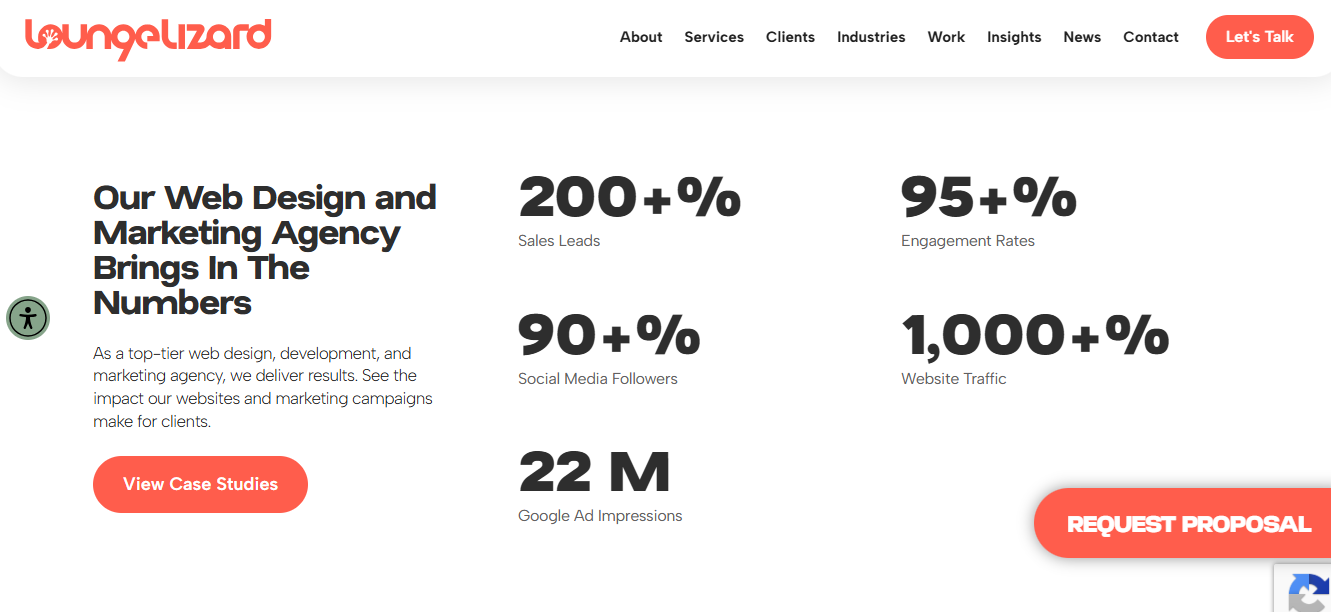
The company provides responsive web design, WordPress development, website modernization, and conversion-focused improvements. Its broader services include content strategy, branding, search optimization, and digital marketing. These capabilities make it more relevant to branded websites than specialized enterprise application architecture.
Lounge Lizard has documented a website modernization project for the American University of Iraq Baghdad. That engagement involved migrating an older website to WordPress. Its portfolio also includes projects combining interface design with accessibility and performance work.
Clutch lists Lounge Lizard with a 4.8/5 rating from 43 reviews. Its published rates fall within the higher agency pricing range in this shortlist. Businesses should clarify the balance between development work and marketing services before contracting.
Best suited for: Corporate websites, branding-led redesigns, educational institutions, and customer-facing web experiences.
Pricing: 150–199 per hour, with a listed minimum project size of $25,000.
Quick Comparison of the Top Front End Development Companies
The 15 companies offer different combinations of technical expertise, development services, and pricing arrangements. Some focus on React-based applications, while others specialize in websites, product engineering, or dedicated development teams. This comparison helps identify suitable providers before requesting detailed proposals.
| Company | Location | Main Specialization | Hourly Rate | Minimum Project | Clutch Rating |
| Gilzor | Poland / Cyprus offices | React, Next.js, SaaS interfaces | Custom quote | Not published | Not confirmed |
| Merixstudio | Poland | Custom applications, React, Angular | 50–99 | $25,000+ | 4.8/5 |
| Cleveroad | USA / Estonia operations | Custom applications, React, Vue.js | 25–49 | $10,000+ | 4.9/5 |
| Vention | USA | Engineering teams, React, Angular | 50–99 | $50,000+ | 4.9/5 |
| Netguru | Poland | Digital commerce, product engineering | 50–99 | $50,000+ | 4.8/5 |
| WPWeb Infotech | India | Web development, React, WordPress | Under $25 | $25,000+ | 5.0/5 |
| Devox Software | International operations | Application modernization, web engineering | Custom quote | Not confirmed | Not confirmed |
| KitRUM | USA / Poland | React migration, custom software | 50–99 | $25,000+ | 5.0/5 |
| eSparkBiz | India | Outsourcing, custom web development | Under $25 | $10,000+ | 4.9/5 |
| Thoughtbot | USA | Product design, React, custom software | 150–199 | $10,000+ | 4.9/5 |
| Tooploox | Poland | Software engineering, React, AI | 50–99 | $25,000+ | 4.8/5 |
| Orbit Media | USA | Business websites, WordPress | 150–199 | $50,000+ | 5.0/5 |
| Shakuro | UAE | React, Next.js, product design | 25–49 | $5,000+ | 5.0/5 |
| BairesDev | USA | Nearshore engineering, React, Angular | 50–99 | $50,000+ | 4.9/5 |
| Lounge Lizard | USA | Website design, development, branding | 150–199 | $25,000+ | 4.8/5 |
For custom applications, prioritize relevant software engineering experience over website design portfolios. For corporate websites, consider providers combining front-end implementation with content management and user experience expertise. Always verify the proposed team, delivery scope, and total budget before making a final decision.
How We Selected These Front End Development Companies
The shortlist uses documented technical capabilities, project experience, client feedback, and public commercial information. Companies were considered for their relevance to front-end development and related web engineering services. The resulting list includes specialist providers and broader agencies that can meet different project requirements.
The research considered six evaluation areas:
| Evaluation Area | What to Check |
| Technical expertise | Documented experience with React, Angular, Vue.js, Next.js, and related technologies |
| Project experience | Relevant applications, published case studies, and comparable industry work |
| Client feedback | Independent review platforms, review counts, and specific delivery experiences |
| Engineering quality | Testing practices, accessibility, performance, and code maintainability |
| Commercial transparency | Hourly rates, minimum project budgets, and engagement models |
| Project suitability | Fit for startups, SaaS products, enterprises, or business websites |
Technical relevance received the greatest editorial emphasis because this article targets front-end development buyers. A broad software portfolio alone does not prove expertise in modern interface engineering. Relevant case studies and technology-specific service information provide more useful evidence.
Company websites were used to assess advertised capabilities and published project examples. Clutch profiles supplied independently hosted client feedback and publicly listed commercial information. Company-reported performance claims were not treated as independently verified results.
This is a curated shortlist rather than a mathematically scored ranking. No direct interviews, code audits, or controlled development tests were conducted for this article. Readers should verify current staffing, project availability, and contractual terms before hiring.
What Services Do Front End Development Companies Offer?
Front end development companies build and maintain the parts of websites and applications that users interact with. Their work combines interface engineering, responsive implementation, integration, testing, and technical maintenance. The exact service scope depends on the agency and project requirements.
Custom Front-End and Web Application Development
Custom front-end development creates interfaces designed around specific business functionality. Developers use technologies like React, Angular, and Vue.js to build reusable interface components. These applications can support dashboards, booking platforms, customer portals, and subscription based software.
A custom application may require secure authentication, user permissions, and live data updates. Front end developers implement the visible functionality while coordinating with back-end engineers. This approach supports software that cannot be delivered adequately through a standard website template.
UI/UX Implementation and Responsive Web Design
UI/UX implementation turns interface designs into functional, accessible, and responsive web experiences. UI refers to visible elements, while UX describes how people interact with a product. Developers translate designs from tools like Figma into navigation menus, forms, layouts, and reusable components.
Responsive design adapts content to smartphones, tablets, and desktop screens. Developers should also support keyboard navigation, readable text, and appropriate color contrast. These practices improve usability across different devices and user requirements.
Front-End Modernization and Performance Optimization
Front-end modernization updates existing applications to improve maintainability, usability, and technical performance. An agency may replace outdated JavaScript, upgrade React, or reorganize poorly maintained components. Modernization can also address slow rendering, unnecessary downloads, and unstable page layouts.
Google’s Core Web Vitals provide measurable performance targets. A good Largest Contentful Paint score is 2.5 seconds or less for the recommended measurement threshold. Agencies should evaluate real-user data alongside laboratory testing before promising performance improvements.
API Integration, Testing, and Ongoing Maintenance
API integration connects the user interface with other software and business functionality. Common examples include Stripe payment processing, inventory databases, customer accounts, and analytics platforms. Development teams must also handle loading states, failed requests, and secure access.
Testing helps identify broken functionality before and after launch. Unit tests check individual components, while end-to-end tests evaluate complete user journeys. Ongoing maintenance may include framework upgrades, accessibility fixes, security patches, and performance monitoring.
What Technologies Should a Top Front End Development Company Know?
A qualified front end development company should understand modern frameworks, core web technologies, and software quality practices. The strongest technology choice depends on the application rather than framework popularity alone. Businesses should request documented experience with their existing or proposed technology stack.
React, Angular, Vue.js, and Next.js
React, Angular, Vue.js, and Next.js support different types of front-end development work. Each offers a different approach to building, organizing, and delivering interactive interfaces. The right choice depends on technical requirements and long-term maintenance expectations.
| Technology | Common Application |
| React | Interactive dashboards, reusable interface components, SaaS applications |
| Angular | Structured business applications and complex enterprise interfaces |
| Vue.js | Progressive web interfaces and interactive applications |
| Next.js | React applications requiring server rendering, routing, and flexible content delivery |
React is a UI library, while Angular and Vue.js are development frameworks. Next.js builds on React and provides additional application capabilities. Buyers should ask why an agency recommends a particular technology for their project.
JavaScript, TypeScript, HTML, and CSS
JavaScript, TypeScript, HTML, and CSS are foundational technologies for modern web interfaces. HTML structures content, while CSS controls layout, styling, and responsiveness. JavaScript enables interactions such as dynamic forms, navigation, and live content updates.
TypeScript adds static type checking to JavaScript development. It can help identify certain programming errors before an application runs. Agencies should also demonstrate knowledge of semantic HTML, browser behavior, and maintainable component architecture.
Performance, Accessibility, and Testing Tools
Professional front-end development requires testing for speed, accessibility, functionality, and browser compatibility. Agencies may use Lighthouse and PageSpeed Insights to investigate loading performance. Playwright, Cypress, and Vitest support different automated testing activities.
Accessibility evaluation may include axe, WAVE, keyboard testing, and screen reader checks. WCAG provides guidance for making web content more accessible. Automated tools can identify many problems, but they cannot replace manual evaluation.
Google recommends the following Core Web Vitals thresholds:
| Metric | Good Threshold | What It Measures |
| Largest Contentful Paint (LCP) | 2.5 seconds or less | Main content loading |
| Interaction to Next Paint (INP) | 200 milliseconds or less | Interaction responsiveness |
| Cumulative Layout Shift (CLS) | 0.1 or less | Visual stability |
These thresholds should be assessed using representative real-user performance data. Meeting them does not guarantee high Google rankings or business conversions. They provide objective benchmarks for discussing technical quality with an agency.
Which Front End Development Company Is Right for Your Project?
The right front end development company depends on your product type, budget, technical requirements, and internal engineering capacity. A startup MVP may need rapid product development and frequent feedback. An established enterprise may prioritize stability, security, integration, and controlled modernization.
Best Fit for Startups and MVP Development
Startups should consider agencies that combine product discovery with practical application development. Cleveroad, Thoughtbot, and Shakuro offer services relevant to early product design and implementation. Their suitability still depends on the startup’s budget, framework requirements, and delivery expectations.
A minimum viable product, or MVP, contains enough functionality to test a business idea. For example, a booking platform may initially need registration, availability, reservations, and payment processing. Founders should ask agencies to separate essential launch functionality from later enhancements.
Best Fit for SaaS and Custom Web Applications
SaaS companies should prioritize maintainable interfaces, reusable components, API integration, and ongoing engineering support. Gilzor, Merixstudio, Vention, and Netguru offer relevant application development capabilities. Their services may support dashboards, subscription functionality, customer portals, and complex product workflows.
SaaS applications often evolve through regular product releases. Therefore, development practices like automated testing and code documentation become important. Buyers should review experience with similar application scale and architecture.
Best Fit for Enterprise and Legacy Modernization
Enterprise projects require careful integration, documented development practices, and reliable migration planning. Merixstudio, KitRUM, Devox Software, and Vention provide relevant modernization or enterprise engineering services. Buyers should examine documented migrations and confirm compatibility with existing software.
KitRUM’s reviewed Angular-to-React project provides one practical migration example. However, replacing an entire interface is not always necessary. Incremental upgrades may reduce disruption when existing functionality still performs well.
Best Fit for eCommerce and Customer-Facing Websites
eCommerce and business websites require responsive interfaces, clear navigation, and reliable customer journeys. Netguru, WPWeb Infotech, Orbit Media, and Lounge Lizard offer relevant web development or digital commerce services. The appropriate provider depends on whether the project needs custom application engineering or a managed website platform.
An eCommerce interface may include product search, filtering, checkout, and account functionality. A B2B website may prioritize service pages, lead generation, and content management. Buyers should compare relevant project evidence rather than assuming every web agency has identical capabilities.
How Much Does It Cost to Hire a Front End Development Company?
Front-end development agency rates in this shortlist range from below $25 to $199 per hour. Actual project costs depend on functionality, development effort, team composition, and contract arrangements. Published hourly rates should be treated as initial comparison information rather than binding quotations.
Hourly Rates and Project Based Pricing
The three common pricing approaches are hourly billing, fixed-price contracts, and dedicated team arrangements. Hourly billing suits projects where requirements may change during development. Fixed-price contracts are more suitable when scope, deliverables, and acceptance criteria are clearly defined.
Dedicated teams normally involve ongoing payment for assigned engineering capacity. This approach can suit SaaS products requiring continuous feature development. Businesses should confirm whether design, testing, management, and maintenance are included.
For example, 400 development hours at $50 per hour equals $20,000. At $100 per hour, the same workload costs $40,000. These examples exclude additional project expenses and do not represent verified agency quotations.
Published minimum project budgets also vary considerably. Shakuro lists $5,000, while Netguru and Vention list $50,000. These amounts indicate agency engagement thresholds rather than expected prices for every front-end project.
Factors That Affect Front-End Development Costs
Project scope, technical complexity, and required development capacity have the greatest influence on costs. A five-page company website usually requires different resources from a subscription platform with complex user permissions. Custom design requirements and third-party integrations also affect estimated effort.
The main cost factors include:
- Application complexity: Landing pages, customer dashboards, enterprise portals, or interactive SaaS applications.
- Design requirements: Existing Figma files, custom design systems, or complete UI/UX research.
- Technology: React, Angular, Next.js, API integration, or framework migration.
- Testing: Browser compatibility, accessibility, performance, and automated quality checks.
- Delivery model: Fixed-price development, hourly billing, or dedicated engineering resources.
- Team composition: Developers, designers, quality assurance engineers, and project managers.
Accurate estimates require a clear description of the requested functionality. Buyers should provide design references, technical requirements, and expected delivery milestones. This information also makes competing quotations easier to compare.
Hidden Costs, Maintenance, and Long-Term Value
The full development budget should include expenses beyond initial interface implementation. Potential additional expenses include hosting, software licenses, integrations, maintenance, and change requests. Projects may also require extra work when requirements change after development begins.
A lower hourly rate does not necessarily mean a lower total cost. Poor documentation, repeated revisions, and inadequate testing can increase future spending. Buyers should compare projected total costs rather than selecting the cheapest rate.
Long-term value depends on application reliability, maintainable code, and useful business functionality. A well-documented interface may be easier for future engineers to improve. Ask for maintenance terms, repository ownership, and handover documentation before approving the final proposal.
How to Choose the Best Front End Development Company
Choosing the best front end development company requires comparing relevant experience, technical quality, communication, and contractual protection. A consistent evaluation method helps businesses assess agencies without relying entirely on rankings. Each shortlisted provider should be reviewed against the same project requirements.
Review Portfolios, Case Studies, and Client Feedback
Start by checking whether the agency has completed projects similar to yours. A SaaS company should examine applications involving dashboards, user permissions, and data integration. A retailer should prioritize relevant eCommerce functionality and customer experience work.
Look for case studies explaining the original problem and delivered solution. Useful evidence includes screenshots, technology details, client feedback, and measurable outcomes. Company-reported results should be clearly distinguished from independently verified claims.
Review ratings on platforms like Clutch, but examine individual feedback as well. Look for repeated comments about communication, quality, deadlines, and budget management. Ask for a client reference when the project involves significant investment.
Evaluate Technical Skills and Code Quality
Technical evaluation should measure real engineering experience rather than familiarity with popular framework names. Ask how the team organizes components, handles errors, and manages application performance. Request examples of testing, documentation, and accessibility practices.
For a React project, discuss component architecture, state management, and API integration. For a Next.js application, discuss rendering choices, caching, and search visibility requirements. A technical discussion with the assigned engineer can reveal important experience gaps.
Request a development plan showing how quality will be measured. Suitable acceptance criteria may include automated test coverage, browser compatibility, and performance thresholds. The criteria should match the project’s technical requirements.
Compare Communication, Timelines, and Engagement Models
Reliable communication requires clear responsibility, reporting expectations, and documented delivery milestones. Ask who manages the project and how progress will be reported. Confirm the team’s working hours and communication overlap with your business.
Compare the available engagement arrangements before signing. A fixed-price model may work for a defined website redesign. A dedicated engineering model may be more suitable for ongoing software development.
Request milestone dates for design approval, implementation, testing, and deployment. Discuss how the agency handles delays and changing requirements. These arrangements should appear in the final agreement.
Check Contracts, Source Code Ownership, and Post-Launch Support
A development contract should define ownership, deliverables, payment terms, and responsibilities after launch. Confirm whether your business receives source code, repository access, deployment credentials, and documentation. Also clarify the use of third-party libraries and software licenses.
Contracts should explain acceptance criteria, change requests, confidentiality, and termination procedures. Buyers should understand what happens if the project ends before completion. Legal review may be appropriate for complex or high-value arrangements.
Post-launch support should cover clearly defined maintenance responsibilities. Ask whether bug fixes, framework upgrades, and security updates require additional payment. A complete handover reduces dependence on the original provider.
Front End Development Agency vs Freelancer vs In-House Team
An agency suits coordinated development projects, a freelancer suits focused tasks, and an in-house team supports continuous product ownership. Each approach has different costs, staffing requirements, and management responsibilities. The right choice depends on project duration and complexity.
| Hiring Option | Suitable Work | Main Advantage | Main Limitation |
| Development agency | SaaS platforms, enterprise applications, complete websites | Coordinated technical and delivery support | Agency overhead and possible minimum budgets |
| Freelancer | Landing pages, component development, focused bug fixes | Flexible, direct engagement | Limited individual capacity |
| In-house team | Continuous product development and maintenance | Direct management and product familiarity | Recruitment and long-term employment costs |
| Dedicated external team | Ongoing development requiring additional capacity | Flexible engineering team extension | Requires effective coordination and oversight |
Choose an agency when the project requires development, testing, design, and delivery management. Agencies can coordinate different specialists under one engagement. However, confirm which people will actually work on your project.
Choose a freelancer when the scope is limited and easy to define. Examples include responsive layout fixes, individual React components, or minor interface updates. Complex projects may require additional coordination beyond one person’s capacity.
Choose an in-house team when software development is an ongoing business function. Internal engineers can build deeper knowledge of the product and its users. A dedicated external team may supplement that capacity when hiring demand increases.
Common Mistakes to Avoid When Hiring a Front End Development Company
The most common hiring mistakes involve weak technical verification, unclear project requirements, and incomplete contracts. These issues can increase development costs and create avoidable delivery problems. Businesses can reduce these risks through documented evaluations and clear agreements.
Choosing Based Only on the Lowest Price
A low hourly rate may appear attractive during vendor comparison. However, it does not establish development quality or total project cost. Compare deliverables, estimated hours, testing responsibilities, and maintenance terms before deciding.
Hiring Without Verifying Technical Experience
A company may advertise React or Next.js without demonstrating relevant production experience. Ask for comparable applications, technical explanations, and client references. Verify the actual experience of assigned engineers rather than relying only on the agency portfolio.
Ignoring Performance and Accessibility
A visually attractive interface can still perform poorly or exclude some users. Include performance targets, accessibility requirements, and browser testing in the project scope. Test representative mobile devices rather than relying only on desktop previews.
Starting Without Clear Project Requirements
Unclear requirements make development estimates less reliable. Document user journeys, integrations, essential functionality, and expected delivery milestones. Agree on how additional work will be estimated and approved.
Overlooking Communication and Delivery Risks
Poor communication can delay decisions and hide development problems. Establish regular reporting, clear responsibilities, and a defined escalation process. Confirm how changes, blockers, and missed milestones will be communicated.
Failing to Clarify Code Ownership and Maintenance
Businesses should know who controls the application after delivery. Contracts should address source code, repositories, documentation, and third-party software. Confirm the availability and cost of post-launch support before development ends.
Frequently Asked Questions About Front End Development Companies
What does a front end development company do?
A front end development company builds the visible and interactive parts of websites and applications. Its work includes interface implementation, responsive design, API integration, and performance optimization. Some agencies also provide product design, back-end engineering, and ongoing maintenance.
Which front end development companies are suitable for startups?
Cleveroad, Thoughtbot, Shakuro, and Gilzor offer services relevant to startup product development. Their capabilities include custom interfaces, application engineering, and product development support. The best fit depends on the startup’s budget, technology requirements, and planned launch scope.
How long does a front-end development project take?
Development time depends on functionality, design readiness, integrations, and team capacity. A small landing page may require days or weeks, while complex applications can take several months. Request a project-specific timeline with milestones rather than relying on general estimates.
Is outsourcing front-end development worth it?
Outsourcing can provide access to engineering expertise without building an entire internal team. It may suit temporary projects, specialized development work, or ongoing team extension. Its value depends on delivery quality, communication, total cost, and long-term maintenance requirements.
How can I verify a front-end company’s expertise?
Review completed projects, independent client feedback, and the experience of assigned engineers. Ask how the team handles testing, application architecture, performance, and accessibility. A focused technical interview can help confirm its suitability for your project.
Should I hire a React specialist or a full-service development agency?
Hire a React specialist when the project mainly requires React interface engineering. Choose a full-service agency when development also involves product design, back-end functionality, infrastructure, and testing. Confirm the actual technical responsibilities before selecting either approach.
Can a front-end development company improve an existing website?
Front-end agencies can improve responsive layouts, performance, accessibility, and outdated interfaces. Modernization may involve replacing legacy components or upgrading an existing framework. A technical audit should identify which improvements are necessary before a full rebuild.
What questions should I ask before hiring a front-end development agency?
Ask about relevant experience, assigned engineers, project costs, delivery milestones, and source-code ownership. Request examples of technical quality checks and post-launch maintenance arrangements. Compare written answers from several agencies before making a final selection.
Final Thoughts: Choosing the Right Front End Development Partner
The best front end development company is the one that matches your technical requirements, project scope, and budget. Gilzor, Merixstudio, Cleveroad, Vention, and the other companies in this comparison offer different engineering capabilities. Their published ratings and service information can support initial research but should not replace direct evaluation.
Start by shortlisting three companies with relevant project experience. Compare their proposals using consistent requirements for cost, quality, delivery, and ongoing support. Prioritize verified expertise, clear communication, and maintainable software over ranking position or hourly price alone.